What is training load?
Training load is the total amount of work a horse does over a period. It has two parts: volume (how long, how far) and intensity (how demanding). A relaxed 45-minute hack and a 20-minute intense jumping session may be similar in time, but their effect on the horse is very different. So “how many days was it ridden” is not enough; the type, length and difficulty of each session matter. Even a simple low–medium–high scale is a good enough start to see how the week really went.
Load is neither good nor bad in itself. Improvement happens during the recovery that follows an appropriate load. Problems tend to appear in weeks when load rises too quickly, hard days are stacked back to back, or rest is treated as an “empty day” and quietly dropped.
The shape of the week: hard day, easy day, rest
A simple structure many trainers use is to alternate hard and easy days and to give the week at least one full rest or turnout day. A hard day is one where the horse is challenged technically or physically; an easy day is made up of recovery work such as light flatwork, stretching, hacking or lungeing.
| Day | Type of work | Intensity | Note |
|---|---|---|---|
| Monday | Rest or turnout | Very low | After a weekend competition or a hard session |
| Tuesday | Flatwork (dressage basics) | Medium | Generous warm-up and cool-down |
| Wednesday | Hack or light fitness work | Low | Different ground, mental freshness |
| Thursday | Technical session (jumping or discipline-specific) | High | The main hard day of the week |
| Friday | Lungeing or light flatwork | Low | Focused on recovery |
| Saturday | Fitness work or a second technical day | Medium–high | Eased off in a competition week |
| Sunday | Short walk or turnout | Low | Preparing for the week ahead |
This table is an example, not a template. The same week looks very different for a young horse, a horse in rehab and a competition horse in mid-season. What matters is the principle: a hard day is always followed by a lighter one.
Building load gradually
A horse coming back from a long break, starting a new discipline or preparing for the season should have its load built up step by step. Muscle and the cardiovascular system adapt relatively quickly, while tendons, ligaments and bone take longer. That is why doubling the work overnight is risky even when the horse “looks ready”.
- Don't raise duration and intensity in the same week; increase one and hold the other
- After a few weeks of building, plan a lighter recovery week
- Count a change of surface (grass, sand, roadwork) as load too
- Treat travel and competition days as part of the weekly load
- Plan return-to-work programmes, especially after injury, together with your vet
Rest is part of the plan, not a gap in it
A rest day is not “the day nobody got round to riding”; it is a planned recovery day. Ideally the horse spends it turned out, moving around and behaving like a horse. Where turnout is not possible, in-hand walking or the horse walker can be a light alternative. Writing rest days into the calendar in advance also stops them quietly disappearing in a busy week; the day after a competition or a long journey deserves particular protection.
Rest is not only physical. A horse that repeats the same exercises in the same arena day after day gets mentally stale too. Hacking out, new surroundings and a variety of work help keep the horse willing and attentive.
Adapting the plan to the horse and the season
Two horses on the same yard cannot carry the same week in the same way. When writing the weekly plan, ask a few questions for each horse separately:
- Age and experience: short, frequent and varied sessions for young horses; longer warm-ups and cool-downs for older ones
- Season: base fitness before the season, maintenance and fine-tuning around competitions during it, and a planned break at the end
- Rider: if more than one person works the horse during the week, everyone should see the same plan and the same notes
- Yard conditions: turnout time, the state of the ground and the weather decide how much of the plan can really be delivered
Warm-up and cool-down are part of the load too. Cutting them short on busy days may look like it saves time, but it makes recovery harder. Writing those times into the plan means grooms and riders work to the same expectations.
Reading the horse's signals
However good the plan looks on paper, the horse has the final say. Signs that the load is too much are often small and scattered: the groom sees one thing, the rider feels another, the trainer notices a third. Bringing those observations together in one place is what makes the picture visible.
Daily load and recovery checklist
- Are appetite and water intake normal
- Is the horse bright and willing in the stable and on the way to work
- Any new filling, heat or tenderness in the legs
- Are the strides even, with no sign of stiffness or lameness
- Do breathing and sweating return to normal in the expected time after work
- Has the rider reported anything that felt different from usual
- Were the type, length and intensity of the session recorded the same day
When one or more of these signs appears, easing the next day's plan is far smarter than pushing the load through the rest of the week. We cover lameness and colic in a separate article; for planning competition weeks, see our guide to competition season planning.
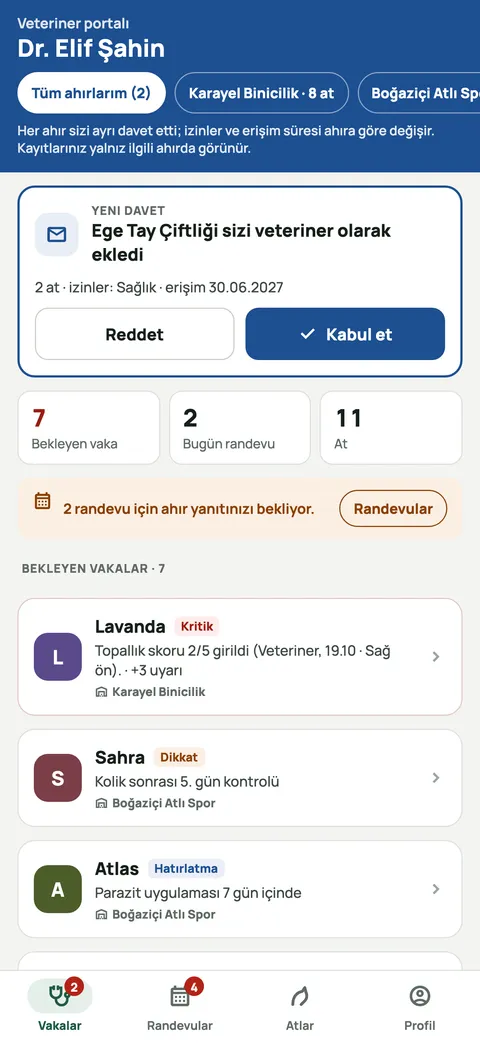
Tracking training load with Equ Crm
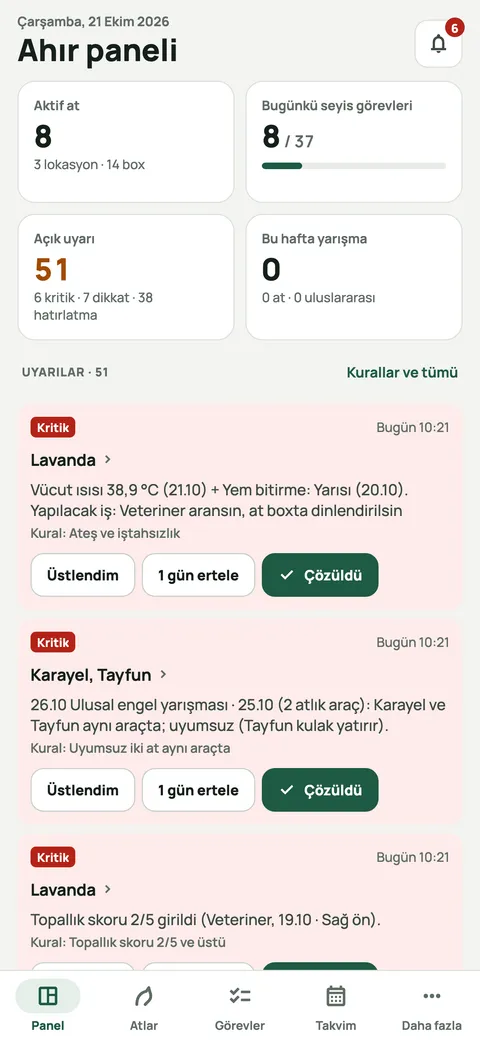
In Equ Crm, every horse profile holds training records and videos. You can log a session in a few taps by choosing from the 44 training types in the ready catalogue, and see over the weeks which kinds of work were done and how often. Because vet, farrier, physio and competition appointments sit in the same weekly calendar, you see the rest of the week while you plan the load.
Grooms' jobs such as turnout, the walker and cooling off appear in their task lists per horse and time. Alert rules for situations such as a lameness score or loss of appetite let the trainer know in time. Performance reports by period show how the plan is working over the longer term. To see how it would fit your yard, you can book a demo.