Why spotting it early matters so much
Horses often carry pain quietly. A horse that leaves half its breakfast, hangs back from the group in the field or stands oddly in the stable may be trying to tell you something. The person most likely to catch those signs first is usually not the vet but the groom who grooms, feeds and leads that horse every day.
So two things need to be settled on the yard: everyone knows what “normal” looks like, and everyone knows who to call and what to record when something goes wrong. This article is not about learning to diagnose; it is about making observation and first response consistent.
First, know your horse's normal
To tell whether a reading is high, you need to know what that horse looks like on a calm day. Taking and recording each horse's resting temperature, pulse and respiration a few times gives you a baseline to compare against in an emergency. Having grooms learn to take these readings properly, hands-on with your vet or an experienced team member, is time well spent.
| Measure | Typical range | How to check |
|---|---|---|
| Temperature | About 37.5–38.5 °C | Rectal digital thermometer |
| Heart rate | About 28–44 beats/min | Artery under the jaw, or a stethoscope |
| Respiration | About 8–16 breaths/min | Count the movements of the flank |
| Gut sounds | Regular gurgling on both sides | Ear or stethoscope against the flank |
| Gums | Pink and moist | Lift the lip and look |
Take readings in the same conditions, with the horse settled rather than straight after work. What matters is less any single number than how it has changed from that horse's own normal.
Early signs of lameness
Everyone sees an obvious lameness. The hard part is catching the subtle changes a rider might describe as “a bit reluctant today”. Watch for:
- A head nod in trot, with the head lifting on one stride and dropping on the other
- Constantly resting one leg in the stable, or frequently shifting weight between legs
- More heat than usual in a leg or hoof, a strong digital pulse, or swelling
- Shorter strides on turns, on hard ground or going downhill
- Unusual resistance under saddle, or reluctance to go in one direction
- Reluctance to pick up a foot for picking out or the farrier
Vets usually grade lameness on a standard scale; a common example is the AAEP 0–5 scale. Rather than giving a score on the yard, describe clearly what you see, which makes the vet's job easier: which leg, which gait, which surface, and since when.
What to do on the yard when you see lameness
- Stop work and bring the horse calmly back to its stable.
- Check the legs and feet: a lodged stone, a lost or twisted shoe, a wound, swelling or heat?
- If you find a nail or other object penetrating the hoof, do not pull it out yourself; keep the horse still and call the vet. Where it sits may matter for the assessment.
- Take the temperature and note your observations with times; film a short video if you can.
- Call your vet and describe what you have seen. Do not give any medication until instructed.
- If the problem involves a shoe or the hoof, bring in the farrier as directed by your vet.
Put the numbers for the vet, the farrier and the manager to call in an emergency somewhere everyone on the yard can see them. A groom on the late shift who does not have to work out who to ring saves minutes.
Early signs of colic
Colic is not a single disease but the general term for abdominal pain, ranging from mild discomfort to life-threatening conditions. You cannot tell which on the yard, so a suspicion alone is reason enough to call the vet.
- Not eating or leaving feed, not drinking
- Looking at the flank, kicking at the belly, repeatedly lying down and getting up, rolling
- Restlessness, pawing, lying flat for long periods
- Sweating, raised heart rate and breathing
- Fewer or no droppings, quieter gut sounds
- Stretching as if to urinate, an unusual stance
Colic cannot always be prevented, but some yard habits help reduce the risk: regular feeding times, changing feed or hay gradually over several days, constant access to clean water, plenty of forage and regular movement through turnout or walking. Writing these habits into the groom routine also means you know who fed what, and when.
If you suspect colic
- Call the vet at once and pass on the horse's condition and your readings
- Remove feed and hay from the stable; follow the vet's instructions on water
- Take temperature, pulse and respiration and note them with times
- Record when the last droppings were passed and what they looked like
- Note the last feed time, any feed changes and the last exercise
- Give the horse a safe space where it cannot injure itself; do not put yourself at risk
- Wait for the vet's guidance before walking the horse or doing anything else
- Give no medication unless the vet tells you to
- Check the lorry and a driver are available in case referral is needed
Recording observations and tracking with Equ Crm
Little stays in anyone's head during an emergency. When it is written down what was measured at what time, when the last droppings were seen and who did what, the vet can make a better decision and you can see later whether the same thing keeps happening.
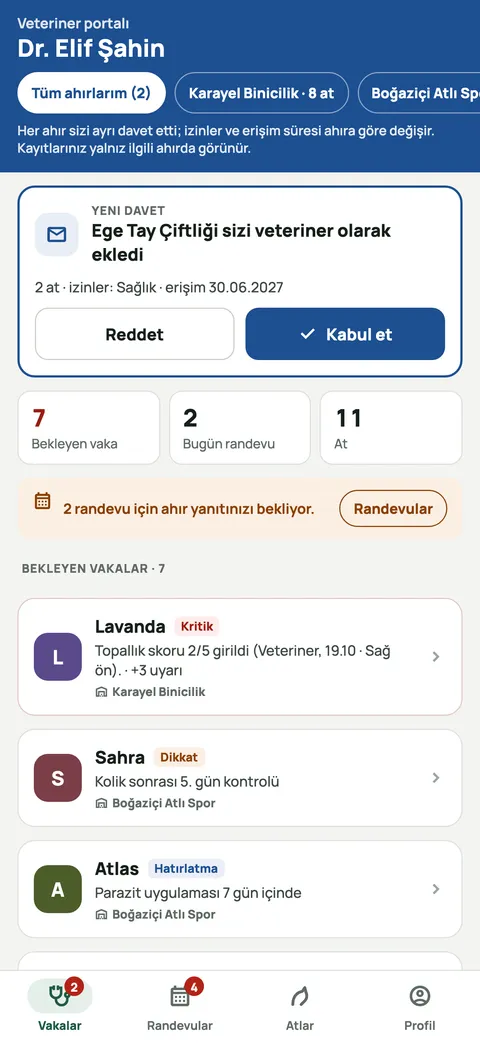
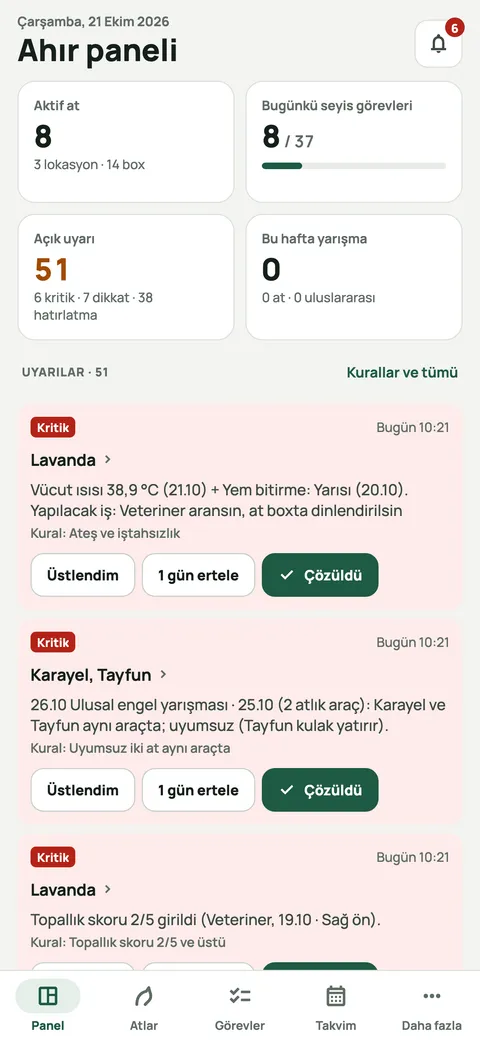
In Equ Crm, jobs such as the daily temperature check, checking how much feed was eaten or checking feet land on the groom task list under the horse and the time. The groom marks the job with one tap and attaches the reading, a photo or a video as proof; marking works offline too and syncs when the connection returns. The person in charge approves the entry or sends it back with a note.
Alert rules catch situations such as fever together with loss of appetite, a particular lameness score being entered or an expected entry going missing, and raise an alert at critical, attention or reminder level. Someone claims the alert, snoozes it or resolves it, and the right people receive notifications by mobile push or email. All health records build up on the horse's profile; vet appointments sit in the calendar, and messages with the owner are kept with that horse.
For yearly preventive care, see our article on the vaccination and deworming schedule, or book a demo to set up your own yard's rules together.