Why it matters so much
Competition rules exist to protect horse welfare and fair sport. Within them, substances that must not be present in a competing horse are defined, and samples may be taken at events. Under FEI rules, responsibility rests largely with the athlete as the “Person Responsible”, but in practice everyone on the yard shares it: the vet who prescribes, the groom who administers, the trainer who sets the programme and the owner.
Most problems come not from bad intent but from gaps in information. If the rider taking a horse to a show at the weekend does not know about a treatment given on Monday, if nobody checked what was in a supplement, or if two horses got mixed up, the outcome is the same. So half of this subject is knowing the rules, and the other half is consistent record-keeping.
Withdrawal time versus detection time
These two terms are often confused. A detection time is information about how long after a given dose a substance was no longer detected in samples, in a study carried out under specific conditions. Some authorities publish this kind of information for certain substances. It is not a guarantee: the study conditions may not match your horse's.
A withdrawal time is the period your vet sets, based on the detection time and their own judgement, usually including a safety margin. In other words, it is a decision specific to the horse and the situation. How long a substance can be detected depends on many factors:
- The substance itself and the product's formulation
- The dose, the number of administrations and the length of treatment
- The route (oral, injection, intra-articular, topical and so on)
- The horse's age, weight, metabolism, health and fitness
- Other medications and products used at the same time
That is why relying on a time that worked for another horse, a figure read online or “it was fine last time” is risky.
Which rules apply?
The competition a horse is entered for determines which rules apply. International equestrian sport runs under FEI rules; the FEI publishes the FEI Equine Prohibited Substances List, which separates banned substances from controlled medication and is updated periodically. The current list, the related regulations and Clean Sport resources are on the FEI's official site.
National competitions follow the rules of the national federation, and racing follows the rules of the relevant racing authority. These rules can differ; something permitted under one body may be prohibited under another. Check the current text from the relevant authority at the start of every season and whenever a rule change is announced.
What to record for every administration
A good medication record should answer “what was given to this horse, when, by whom and why” within seconds. The fields below are a starting point for every administration on your yard.
| Field | Why it matters |
|---|---|
| Date and time | This is where any withdrawal period starts; record the time, not just the day |
| Horse | Prevents mix-ups between horses with similar names or neighbouring stables |
| Product name and batch number | Identifies exactly which product was used and allows it to be traced |
| Dose as prescribed | The dose your vet prescribed; never changed on the yard |
| Route of administration | The same substance given by a different route may be detectable for a different time |
| Who administered it | Makes responsibility clear and shows who to ask |
| Vet and prescription or instruction | The basis for the treatment; keep the written instruction |
| Planned competition and the vet's view | Makes any clash between treatment and the show calendar visible |
Keep records after treatment ends. If you ever need to query a sample result or explain compliance with a rule, you may need the record of an administration from months earlier.
A pre-competition check routine
As soon as the competition calendar is set, medication records should be read alongside it. A short check a few days before the horse travels prevents a last-minute surprise.
Pre-competition medication checklist
- Competition calendar shared with the vet in advance
- Every treatment and supplement from recent weeks reviewed in the records
- Vet's view on competing obtained and noted for each treatment
- Rules the event runs under (FEI, federation, racing authority) and the current prohibited list checked
- Any newly started feed, supplement or topical product identified
- Rider, trainer and owner told about the horse's recent treatments
- Required documents (passport, any veterinary forms) ready
- Medication and products taken to the show labelled and recorded
Discipline within the team
The safest yards are the ones that never leave medication to one person's memory. A few simple rules make a big difference:
- Keep medication in a locked cabinet, separated by horse and clearly labelled.
- Never give one horse's medication to another, even when the problem looks the same.
- Write down verbal instructions too, and put medication first in every shift handover.
- Be clear about who can see and who can edit health records.
On livery yards, products that owners bring in themselves need extra care. A supplement or ointment given by an owner should also go into the record and be brought to the vet's attention; otherwise the yard may face the consequences of something it never knew about.
Keeping records with Equ Crm
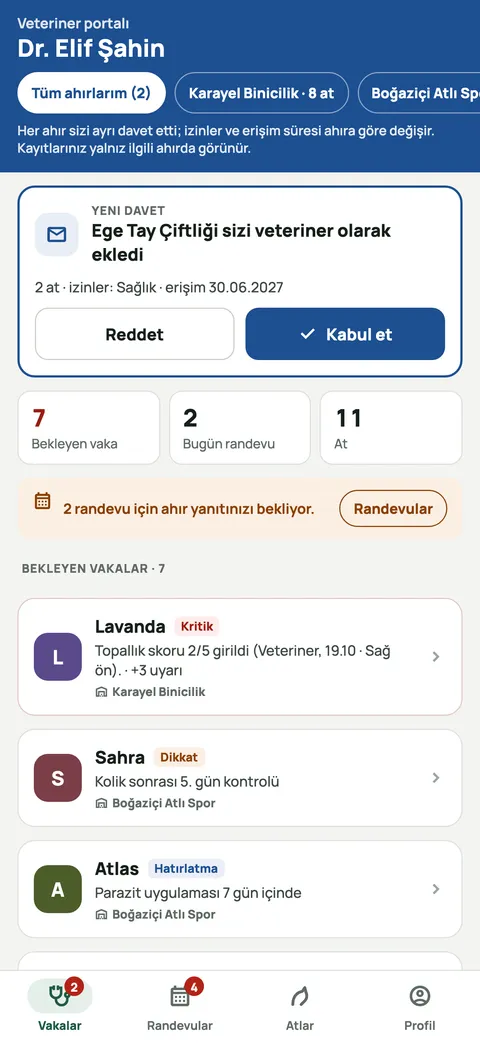
In Equ Crm, each horse's profile holds health records and vaccinations, with “need to know” notes and allergies at the top; you can log administrations there with the date, time and notes. Competitions, vet appointments and transport sit in the same weekly calendar, so it is easy to see how close a treatment is to a show.
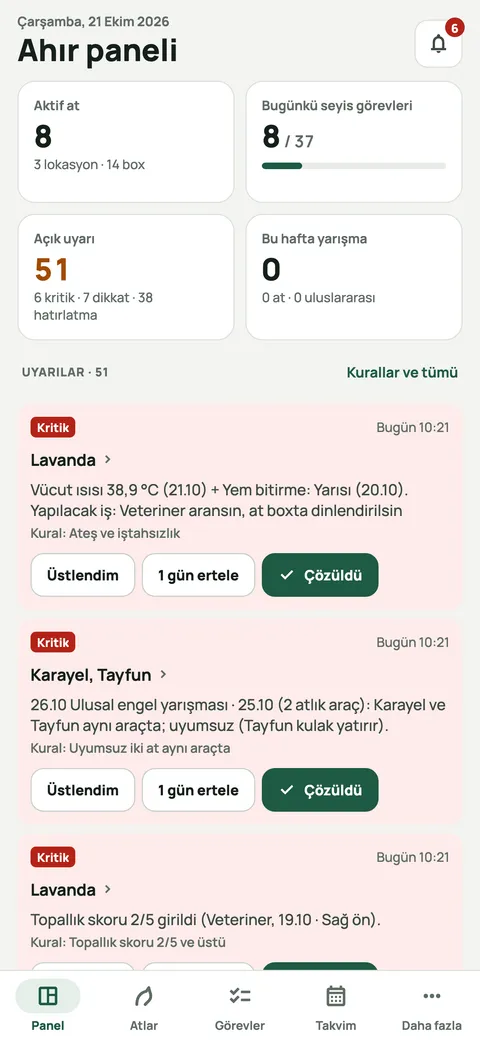
Roles and permissions are set per module, so you decide who can view and who can edit health records, and important actions are kept in the access log. You can receive periodic health reports by email automatically or share them with your vet through a time-limited link. Ready-made and custom alert rules also help catch issues such as missing data entries.
To plan the whole season, see our article on competition season planning. We can talk through moving your existing records across in a demo.