What gets lost at handover?
The most valuable information about a horse is often a small observation: "left half his lunch", "a bit of heat in the left hind", "got silly on the walker". When the person who noticed it finishes their shift and goes home, the information goes with them. If it wasn't written down, the next team starts from scratch.
What gets lost usually falls into three kinds: observations (changes in a horse's condition), changed instructions (a new request from the vet, trainer or owner) and unfinished jobs (a bandage not done, a farrier who didn't turn up, feed about to run out). A good handover passes on all three, the same way, every time.
Setting up the shift pattern
The shift pattern depends on the size of the yard, the number of horses and the work programme. What matters is that it is always clear who is responsible in each part of the day. The table below is an example; adjust the times and duties to your own yard.
| Shift | Main responsibilities | Handover point |
|---|---|---|
| Morning | Morning check, breakfast, mucking out, exercise prep | Midday, short handover to the afternoon team |
| Afternoon / evening | Bringing in, post-exercise care, evening feed, close-down | Written handover at close-down to the late check or next morning |
| Late check | Final round, water and hay, keeping an eye on unsettled horses | To the morning team at the morning check |
| Weekend | Core care with a reduced team | Detailed handover on Friday evening and Monday morning |
Leaving a 15–20 minute overlap between shifts is the simplest way to avoid a rushed handover. Where an overlap isn't possible, a written handover note becomes essential. Each shift also needs a named lead: when the person handing over and the person taking over are clearly identified, the "I told you" versus "nobody told me" argument disappears. On a small yard this is usually the head groom; on a larger one each barn may have its own shift lead.
What should the handover cover?
A handover note doesn't need to be long, but it should always follow the same headings. That way, whoever reads it can see at a glance if something is missing.
Groom handover checklist
- Horses whose condition has changed: off feed, swelling, a wound, lameness, a change in behaviour.
- Treatments given on the vet's instructions: what was done, when the next one is due and who is doing it.
- New or changed instructions: feed plan, turnout restrictions, cancelled exercise, bandaging.
- Jobs not done or only half done, and why.
- Appointments in the next shift: vet, farrier, physio, transport.
- Horses leaving or arriving at the yard.
- Faults and stock: drinkers, doors, lights, feed and bedding levels.
- Any horse that needs watching overnight: who checks, and how often.
How to hand over: short, written, face to face
The best handover is a short face-to-face conversation based on a written record. A verbal handover alone gets forgotten; a written one alone can be skimmed. A practical sequence:
- Write as you go: don't save observations for the end of the shift; note them on the horse's record as soon as you see them.
- Urgent first: start with horses that need attention, and leave routine information for last.
- Show, don't just tell: if there is swelling or a cut, take the incoming team to the stable; if there is a photo, show that too.
- Give every open job an owner: for each unfinished task, answer "who is following this up now?"
- Confirm it was received: the person taking over confirms they have read and understood the note.
If the daily routine behind the handover is vague, the handover will be too. To get the routine written down, see our article on the daily groom routine.
Weekends, holidays and new staff
Handovers are weakest when the team changes. Weekends run on fewer people, someone else takes on the horses of a groom who is on holiday, and new staff don't know the horses yet.
- Friday handover: the note left for the weekend team should be more detailed than a weekday one, with the contact number of the person on call and the vet clearly written down.
- Before leave: a groom going on longer leave should leave a short summary for their horses: quirks, habits, things to watch for.
- New staff: should work alongside an experienced groom for the first few days. When allergies, temperament notes and "need to know" are on each horse's profile, they learn much faster.
- Casual help: a day worker or student should see and tick only the jobs given to them.
Who owns open jobs, and who to call
The most common handover failure is everyone assuming someone else has dealt with it. The fix is that every open job has an owner. A job without an owner stays in the air through every shift change.
Alongside that, set a simple escalation chain: if a groom is unsure about something, they go to the head groom first, then the yard manager if they can't reach them, and straight to the vet for any urgent health concern. Put the chain up somewhere visible on the yard and make sure it is saved in everyone's phone. Our article on lameness and colic can help you judge what counts as urgent.
Review the handover regularly
A handover routine that is set up once and left alone slowly slackens. Notes get shorter, headings get skipped, the overlap turns into a tea break. Once a month, the head groom and yard manager should look back over recent handovers together and ask:
- Was anything noticed late because it wasn't handed over?
- Was the same job done on both shifts, or not at all?
- Which heading is always empty, and which is needlessly long?
- Can new staff actually follow the handover note?
Treat each slip as a gap in the system, not one person's fault. When grooms feel able to own up to mistakes, the handover improves on its own.
How Equ Crm makes handover easier
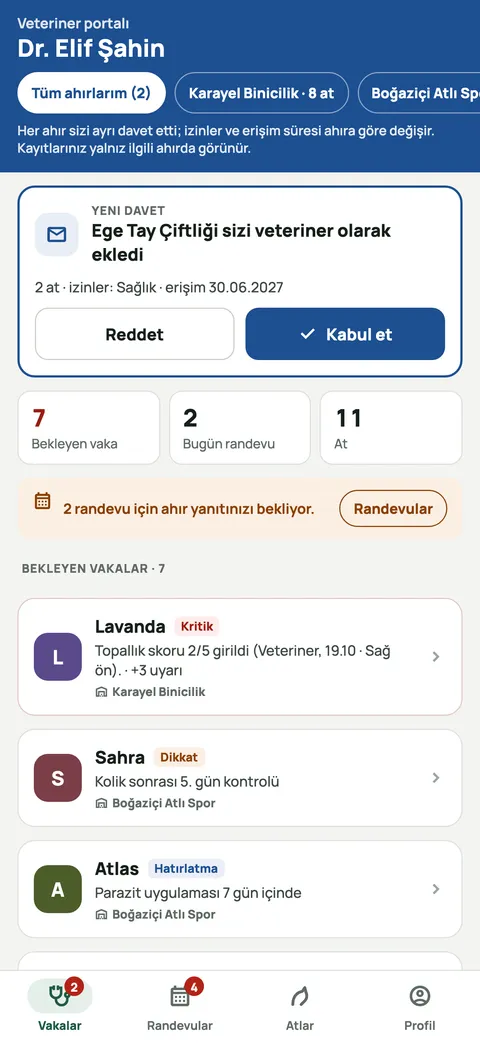
With Equ Crm you don't need a separate handover book, because the information already sits with the horse. Groom tasks are listed per horse and per time slot, so the incoming shift sees straight away what has been done, what is outstanding and who ticked it. Jobs backed by a photo, video or measurement, and tasks the manager sent back with a note, show up in the list too. Each horse's profile keeps allergies and "need to know" notes at the top.
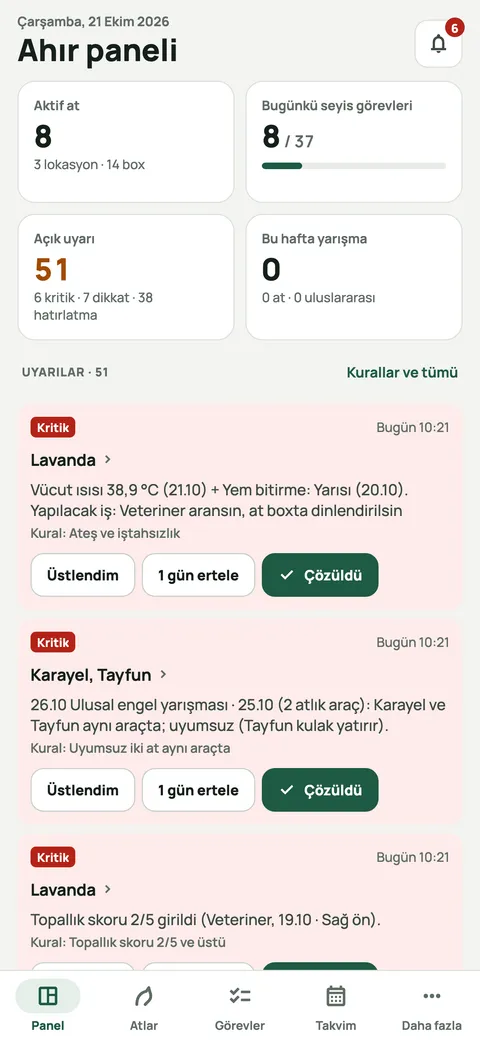
Alert rules catch situations such as a temperature with loss of appetite, or missing data entries; one person claims the alert, snoozes it if needed and resolves it when it is dealt with. That way an open job keeps its owner even when the shift changes. Notifications arrive by mobile push or email, and everyone chooses their own channels. Find out more in the groom module, or book a demo.